Meta Description:
Learn 5 ways to use AI for Facebook and Google Ads in 2026 to improve ad copy, targeting, budgets, creative testing, and PPC performance
“Stop wasting ad money. Let AI do the optimization for you.”
Running Facebook and Google Ads in 2026 isn’t simply about launching a campaign and waiting for conversions. Competition is higher, customers have more choices, and even small mistakes in targeting, creative, bidding, or budgets can quickly increase your cost per result.
This is where Artificial Intelligence can give PPC managers and business owners a serious advantage.
From generating stronger ad copy to identifying high-value audiences and analyzing campaign performance, AI can process large amounts of advertising data much faster than a human.
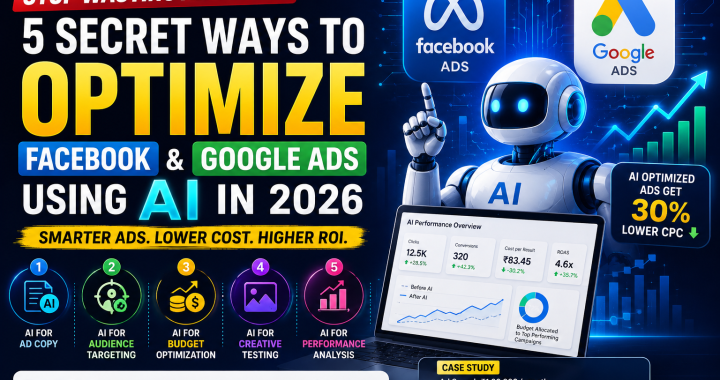
In this guide, we’ll explore 5 secret ways to optimize Facebook and Google Ads using AI in 2026, along with practical examples and a simple case study.
Important: The claim “AI optimized ads get 30% lower CPC” should be treated as a marketing benchmark rather than a universal result. Actual CPC improvements depend on campaign quality, industry, competition, audience, and optimization strategy.
Way 1: AI for Ad Copy
Your ad copy has a direct impact on clicks and conversions.
Instead of writing one headline and hoping it works, use AI to generate multiple variations based on different customer motivations.
Generate Multiple Headlines
For example, a PPC manager promoting a digital marketing service could ask AI to create:
- Problem-focused headlines
- Benefit-focused headlines
- Urgency-based headlines
- Question-based headlines
- Offer-focused headlines
A prompt could be:
“Create 15 Google Ads headlines for a digital marketing agency targeting small business owners. Focus on generating leads, increasing sales, and improving online visibility. Keep each headline concise and conversion-focused.”
You can then test the strongest versions.
Why This Works
AI can quickly identify different messaging angles, allowing advertisers to test more variations without spending hours writing copy.
This makes ai facebook ads strategies especially useful for quickly producing multiple hooks, primary texts, headlines, and CTA variations.
However, don’t blindly publish AI-generated copy. Check every claim, offer, price, and policy requirement before launching.
Way 2: AI for Audience Targeting
The right message shown to the wrong audience can still waste your budget.
AI can help advertisers identify patterns in customer behavior and discover which audiences are more likely to convert.
Use Customer Data
You can analyze information such as:
- Previous purchases
- Website visitors
- Lead quality
- Customer demographics
- Engagement patterns
- Conversion behavior
For example, suppose an e-commerce store discovers that customers aged 25–34 who visit product pages multiple times have a higher purchase rate.
That insight can influence future campaign segmentation and creative strategy.
Facebook and Google AI Targeting
Meta and Google increasingly use machine learning to help advertisers find people who are more likely to take desired actions.
Rather than manually creating dozens of tiny audience segments, advertisers can often give the platform high-quality conversion signals and allow its systems to optimize delivery.
This is one reason ai for ppc 2026 is becoming less about manual targeting and more about supplying strong data and clear conversion goals.
Way 3: AI for Budget Optimization
Budget allocation is one of the biggest challenges in PPC.
Imagine you have a monthly advertising budget of ₹1,00,000 spread across five campaigns.
After two weeks, you discover:
- Campaign A: ₹12 per lead
- Campaign B: ₹18 per lead
- Campaign C: ₹45 per lead
- Campaign D: ₹22 per lead
- Campaign E: ₹65 per lead
Would you continue spending the same amount on every campaign?
Probably not.
Let Performance Guide Allocation
AI-powered advertising systems can analyze signals such as conversions, conversion value, bids, audience behavior, and auction conditions to help optimize delivery.
Instead of making decisions based only on yesterday’s results, automated systems can process many signals simultaneously.
Focus on Conversion Quality
Don’t optimize only for cheap clicks.
A campaign generating ₹10 clicks isn’t necessarily better than one generating ₹20 clicks.
What matters is the business result.
Track metrics such as:
- Cost per lead
- Cost per acquisition
- Conversion rate
- Return on ad spend
- Conversion value
- Lead-to-customer rate
Effective google ads optimization ai should focus on profitable outcomes—not vanity metrics.
Way 4: AI for Creative Testing
Creative fatigue is a common problem in Facebook and Instagram advertising.
An ad that performs well today may gradually lose effectiveness as the audience sees it repeatedly.
AI can help you develop and test more creative variations.
Test Different Creative Elements
Instead of changing everything at once, test individual variables such as:
Hook: “Save 30% on your first order”
vs.
Hook: “Still paying full price?”
You can also test:
- Images
- Videos
- Headlines
- CTAs
- Offers
- Formats
- Customer testimonials
- Product demonstrations
AI can help generate variations quickly, while Meta’s advertising systems can use performance signals to determine which combinations deserve more delivery.
Don’t Test Randomly
Create a testing hypothesis.
For example:
“Customer testimonial creatives will generate a higher conversion rate than product-only images.”
Then compare performance.
This makes your ai facebook ads strategy more data-driven instead of relying on personal opinions about which creative “looks better.”
Way 5: AI for Performance Analysis
PPC dashboards can contain hundreds of numbers.
CTR, CPC, CPM, conversion rate, CPA, ROAS, impressions, reach, frequency, and conversion value can quickly become overwhelming.
AI can help summarize campaign data and identify potential problems.
Ask AI Better Questions
Instead of asking:
“How did my campaign perform?”
Ask:
“Which campaigns have high spend but low conversion value?”
Or:
“Identify campaigns where CPA increased by more than 20% compared with the previous period.”
You can also ask AI to help identify:
- Sudden CPC increases
- Falling conversion rates
- High-spend ad sets with weak results
- Creative fatigue
- Budget opportunities
- Landing-page issues
- Conversion tracking anomalies
This turns raw data into actionable questions.
Tools: Meta AI and Google AI
Meta AI
Meta’s AI-powered advertising systems can assist with areas such as audience delivery, creative optimization, campaign setup, and performance improvements.
Advertisers should understand what automation is doing and provide strong creative assets and accurate conversion signals.
Google AI
Google Ads uses AI and machine learning across bidding, targeting, campaign optimization, and other advertising functions.
Features such as Smart Bidding can use auction-time signals to help optimize bids toward selected conversion goals.
The key lesson is simple: google ads optimization ai works best when your tracking, conversion goals, creative assets, and campaign structure are strong.
AI can’t compensate for fundamentally broken tracking or an unattractive offer.
Case Study: Using AI to Improve PPC Results
Consider a hypothetical e-commerce campaign.
Before AI-assisted optimization:
- Monthly ad spend: ₹1,00,000
- Clicks: 4,000
- Average CPC: ₹25
- Conversions: 80
- Cost per conversion: ₹1,250
- Conversion value: ₹2,40,000
The marketing team used AI to analyze ad copy, identify stronger creative themes, shift budget toward better-performing campaigns, and generate new creative variations.
After optimization:
- Monthly ad spend: ₹1,00,000
- Clicks: 4,800
- Average CPC: ₹20.83
- Conversions: 120
- Cost per conversion: ₹833
- Conversion value: ₹3,60,000
The result:
40 additional conversions from the same advertising budget.
The important point isn’t that every campaign will achieve exactly these numbers.
The lesson is that combining better creative testing, targeting signals, budget decisions, and performance analysis can potentially improve efficiency.
This is the practical value of ai for ppc 2026.
How to Use AI Without Losing Control
AI should support your PPC strategy—not replace your judgment.
Follow these rules:
Give AI Good Data
Poor tracking produces poor optimization.
Make sure conversion tracking is accurate before relying heavily on automated optimization.
Optimize for Business Results
Don’t focus only on CTR or CPC.
Measure leads, sales, revenue, profit, and customer quality.
Test Before Scaling
Don’t immediately increase budgets because of one good day.
Look for consistent performance over a meaningful period.
Keep Human Oversight
Review AI recommendations, generated copy, creative assets, and campaign changes.
Your experience and knowledge of your customers remain valuable.
Conclusion
AI is changing PPC advertising in 2026.
From writing stronger ad copy and identifying valuable audiences to optimizing budgets, testing creative, and analyzing performance, AI can help advertisers manage increasingly complex campaigns.
The biggest opportunity isn’t simply using AI because it’s trendy.
It’s using AI to make better decisions with better data.
Start with one area. Test it. Measure the result. Then expand.
Whether you’re running ai facebook ads, looking for better google ads optimization ai, or building a broader ai for ppc 2026 strategy, the winning combination is AI automation plus human strategy.
Want to improve your ads with AI?
Comment “ADS” and I’ll audit your ad copy with AI for free.