Meta Description:
Is marketing without AI costing your business? Learn AI marketing 2026 strategies, benefits, myths, costs, and how to start with ₹0
“Your competitor is using AI. You are still doing it manually. Who will win?”
Let’s be honest.
Marketing has changed.
Customers expect faster responses. Content needs to be produced consistently. Advertising platforms increasingly rely on automation and machine learning. Competitors are testing more ideas, analyzing more data, and moving faster than ever.
Yet many businesses are still doing everything manually.
Researching topics manually. Writing every caption from scratch. Building reports manually. Testing ads one at a time. Answering the same customer questions every day.
Is marketing without AI automatically a waste of money?
No.
But refusing to use AI when it can clearly make repetitive work faster and more efficient can become expensive.
The real question isn’t whether AI will replace marketers. The question is whether marketers who use AI will outperform those who refuse to adapt.
This guide explores ai marketing 2026, the real cost of manual work, what AI does better, common myths, and how to start using AI without spending ₹1.
Cost of Manual Marketing vs AI Marketing
Consider a small business that needs:
- 20 social media posts every month
- 4 blogs
- Weekly email campaigns
- Advertising reports
- Customer follow-ups
- Market research
A traditional workflow may require hours of repetitive work every week.
AI can assist with brainstorming, outlines, first drafts, research summaries, content repurposing, reporting, and customer communication.
Manual Marketing Costs More Than Money
The biggest hidden cost isn’t always the salary or software bill.
It’s time.
If a marketer spends five hours doing a repetitive task that AI can help complete in one hour, those four hours could have been used for strategy, customer research, creative thinking, or sales.
That’s why businesses should calculate the cost of marketing without AI based on productivity—not just software expenses.
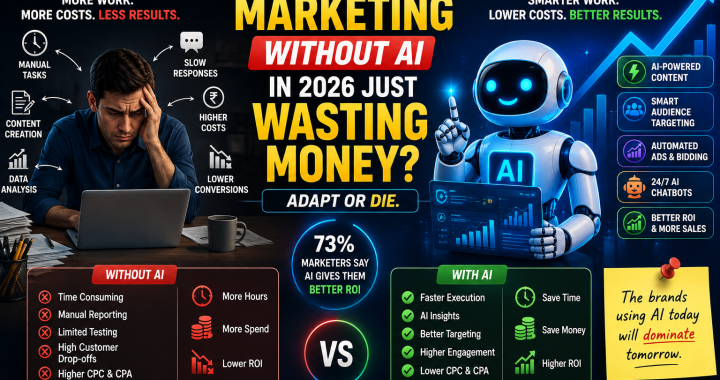
With AI vs Without AI
| Marketing Activity | With AI | Without AI |
|---|---|---|
| Content ideas | Generate and refine quickly | Manual brainstorming |
| First drafts | Minutes | Hours |
| Data analysis | Faster pattern detection | Manual analysis |
| Content repurposing | Highly efficient | Recreate manually |
| Customer FAQs | Automation possible | Staff handles every inquiry |
| Ad variations | More versions can be tested | Fewer variations |
| Reporting | Faster summaries | Manual reports |
| Human strategy | More time available | Less time available |
AI doesn’t eliminate the need for marketers.
It changes where their time goes.
5 Things AI Does Better Than Humans
AI isn’t better than humans at everything.
But there are specific tasks where machines have a major advantage.
1. Processing Large Amounts of Data
Humans struggle to analyze thousands of data points quickly.
AI systems can process large datasets and identify patterns much faster.
This can be useful for advertising performance, customer behavior, website analytics, and sales data.
2. Repetitive Content Production
Creating 30 variations of a headline isn’t exciting work.
AI can generate multiple options quickly, giving marketers more material to review and improve.
3. Speed
AI can help marketers move from idea to first draft much faster.
That doesn’t mean the final content should be published without editing.
It means the blank page disappears faster.
4. Content Repurposing
One blog can become:
- Instagram posts
- LinkedIn content
- Email copy
- Video scripts
- Carousel ideas
- Short-form content
AI can help transform one piece of content into multiple formats.
5. Pattern Recognition
AI can identify patterns in data that humans may overlook.
For example, it can help detect unusual changes in CPC, conversion rates, engagement, or customer behavior.
This is one reason ai marketing 2026 is becoming important for data-driven marketing teams.
What Happens If You Don’t Use AI in 2026?
Let’s be clear: your business won’t automatically fail because you don’t use AI.
But there are risks.
Your Competitors May Move Faster
If another business can create and test 20 marketing variations while you create five, they have more opportunities to discover what works.
Your Team May Spend Too Much Time on Repetitive Work
Highly skilled employees shouldn’t spend most of their day copying data, rewriting captions, or answering identical questions.
Your Marketing Costs Can Increase
When more working hours are required to produce the same output, your effective marketing cost increases.
You May Test Less
Testing is critical in modern marketing.
If producing new ad creatives, hooks, emails, or landing-page ideas is expensive, you may test fewer possibilities.
This is where marketing without AI can become a competitive disadvantage.
How Much Money Do You Lose Without AI?
There isn’t one universal number.
Your actual loss depends on your team size, salary costs, workflow, industry, marketing volume, and the tasks you automate.
Let’s use a simple example.
Suppose a marketer spends 20 hours per month on repetitive tasks.
If their effective hourly cost is ₹500:
20 × ₹500 = ₹10,000 per month
That’s ₹1,20,000 per year spent on those tasks.
Now imagine AI-assisted workflows reduce that workload by 50%.
The potential productivity value becomes:
10 hours × ₹500 = ₹5,000 per month
That’s ₹60,000 of potential annual productivity value.
This doesn’t mean AI automatically saves exactly ₹60,000. The actual result depends on how the recovered time is used.
If the saved time produces more sales, better campaigns, or stronger customer relationships, the value can be even greater.
73% of Marketers Say AI Gives Better ROI
“73% marketers say AI gives them better ROI.”
Stats like this are useful, but don’t blindly trust any AI marketing statistic without checking its original source, sample size, methodology, and definition of “ROI.”
The bigger point remains: marketers are increasingly using AI to improve productivity, campaign performance, and decision-making.
Myths About AI Marketing
AI adoption is growing, but many business owners still hesitate because of common myths.
Myth 1: AI Will Replace Every Marketer
AI can automate certain tasks.
But strategy, positioning, storytelling, empathy, leadership, and customer understanding still require human judgment.
The marketer who knows how to use AI can be more valuable than someone who simply refuses to use it.
Myth 2: AI Content Is Always Bad
Bad prompts often produce generic content.
Good inputs, strong editing, original examples, and human expertise can make AI-assisted content much more useful.
Myth 3: AI Is Only for Big Companies
Small businesses can benefit from AI too.
A local restaurant can use it for content ideas.
A coach can use it to organize leads.
An e-commerce store can use it for product descriptions and customer support.
A freelancer can use it to speed up research and reporting.
Myth 4: AI Marketing Means Zero Human Work
Not at all.
The best workflow is usually:
AI generates → Human reviews → Human improves → Business publishes
Should Businesses Use AI?
Should businesses use AI?
For most businesses, yes—but strategically.
Don’t adopt AI because everyone else is talking about it.
Adopt it when it solves a real problem.
Start with repetitive tasks where the benefits are easy to measure.
For example:
- Content brainstorming
- Meeting summaries
- Email drafts
- Social media variations
- Customer FAQs
- Data summaries
- Marketing reports
- Ad copy variations
The objective isn’t “more AI.”
It’s better marketing with less wasted effort.
How to Start With ₹0
You don’t need a huge technology budget.
Step 1: Find One Repetitive Task
Choose something you do every week.
Step 2: Use a Free AI Tool
Start with a free AI assistant that can help with writing, brainstorming, summarizing, or research.
Step 3: Create a Reusable Prompt
Instead of asking the same question repeatedly, create a structured prompt you can reuse.
Step 4: Keep Human Review
Check facts, tone, originality, and brand accuracy.
Step 5: Measure the Result
Track:
- Time saved
- Content produced
- Leads generated
- Conversion rate
- Cost per result
- Revenue
Step 6: Expand Slowly
Once one workflow works, automate another.
That’s a smarter approach to ai marketing 2026 than buying ten tools and using none effectively.
The Real Cost of Marketing Without AI
The biggest mistake isn’t refusing to use AI.
It’s refusing to experiment.
If AI can help you complete a task faster, test it.
If it doesn’t improve your results, stop using it.
If it works, improve the process.
That’s how modern marketing should operate: test, measure, learn, and adapt.
Businesses asking should businesses use AI shouldn’t focus on whether AI is trendy.
They should ask:
“Where are we wasting time that technology could recover?”
Conclusion: Adapt or Die
“Adapt or die” sounds dramatic—but business has always rewarded companies that adapt to changing customer behavior and technology.
AI isn’t magic.
It won’t fix a terrible product, bad positioning, weak customer service, or a broken sales funnel.
But it can help a good marketer work faster, analyze more information, test more ideas, and spend more time on strategy.
So, is marketing without AI just wasting money?
Not automatically.
But if your competitors use AI to reduce repetitive work, test faster, and make smarter data-driven decisions while you insist on doing everything manually, you’re potentially paying more for the same output.
Don’t replace humans.
Upgrade them.
Don’t automate everything.
Automate what makes sense.
And don’t use AI because it’s fashionable.
Use it because it creates measurable value.
The future belongs to businesses willing to learn, experiment, and adapt.
Agree or disagree? Comment below. And DM “START” for free AI marketing plan.