In today’s competitive online world, having a website is not enough. Your customers need to find you, trust you, and take action. This is where digital marketing comes in.
But with so many marketing options available, business owners often ask: Should I invest in SEO, SMM, or PPC? Which one will give me the best results?
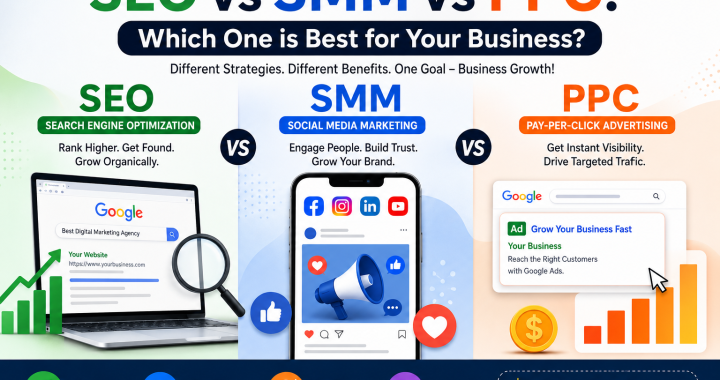
SEO, SMM, and PPC are three powerful digital marketing strategies, but each one works differently. SEO helps your website gain organic visibility, SMM helps you connect with people on social media, and PPC helps you reach potential customers through paid advertisements.
Choosing the right strategy depends on your business goals, budget, audience, competition, and expected results.
In this guide, we will explain SEO vs SMM vs PPC in simple language so you can understand which strategy may be the right choice for your business.
What is SEO?
SEO stands for Search Engine Optimization. It is the process of improving your website so that it can appear higher in search engine results such as Google.
For example, imagine you run a digital marketing company in India. When someone searches for “digital marketing agency in India,” you want your website to appear among the top results.
SEO can help you work toward that goal.
How Does SEO Work?
SEO focuses on different areas of your website and online presence, including:
- Keyword research and useful content
- Website speed and mobile-friendliness
- On-page optimization
- Technical SEO
- Quality backlinks
- Local SEO and Google Business Profile optimization
Benefits of SEO
The biggest advantage of SEO is that it can generate organic traffic without paying for every click.
Other benefits include:
- Long-term visibility
- Increased website traffic
- Better brand credibility
- More organic leads
- Stronger online presence
However, SEO usually takes time. You may need several months of consistent work before seeing significant results, especially in competitive industries.
What is SMM?
SMM stands for Social Media Marketing. It means using social media platforms to promote your business, connect with your audience, and build your brand.
Platforms such as Instagram, Facebook, LinkedIn, and YouTube can help businesses communicate directly with potential customers.
How Does SMM Work?
A social media strategy may include:
- Creating educational and entertaining content
- Posting images, videos, reels, and stories
- Responding to comments and messages
- Running social media advertisements
- Working with influencers or creators
For example, a clothing store can post videos showing new collections, styling tips, customer reviews, and special offers.
Benefits of SMM
SMM is especially useful for businesses that want to build relationships with their audience.
Some benefits include:
- Increased brand awareness
- Better customer engagement
- More website traffic
- Stronger customer relationships
- Opportunities for direct communication
SMM can also make a brand feel more human because customers can interact directly with the business.
What is PPC?
PPC stands for Pay-Per-Click advertising. It is a paid advertising model where advertisers generally pay when someone clicks on their ad.
Google Ads is one of the most popular examples of PPC.
Suppose you own a web development company. You can create an advertisement targeting searches such as “website development company near me.” When someone searches for those terms, your advertisement may appear at the top of the search results.
How Does PPC Work?
A PPC campaign typically involves:
- Selecting relevant keywords
- Creating advertisements
- Choosing your target audience and location
- Setting a budget
- Sending visitors to a landing page or website
- Measuring conversions and results
Benefits of PPC
The biggest advantage of PPC is speed.
Unlike SEO, which can take time to build, PPC can potentially start bringing targeted visitors as soon as your campaign is active.
Benefits include:
- Fast visibility
- Targeted traffic
- Flexible budgets
- Measurable performance
- Quick campaign testing
However, PPC requires continuous spending. Once you stop paying for ads, the traffic generated directly from those ads generally stops as well.
SEO vs SMM vs PPC: Key Differences
Now let’s compare the three strategies.
| Factor | SEO | SMM | PPC |
|---|---|---|---|
| Main Goal | Organic visibility | Engagement & brand awareness | Paid traffic & conversions |
| Cost | Long-term investment | Low to medium | Paid per click/impression |
| Speed | Slow to medium | Medium | Fast |
| Results | Long-term | Short and long-term | Immediate/short-term |
| Best For | Search visibility | Brand building | Quick leads/sales |
| Main Challenge | Takes time | Requires consistency | Requires ad budget |
There is no universal winner. The right choice depends on what your business needs.
SEO vs SMM vs PPC: Which One Should You Choose?
Choose SEO If You Want Long-Term Growth
SEO is a good option if your goal is to build sustainable organic traffic.
It can be particularly useful for:
- Businesses with informative websites
- Local businesses
- Service providers
- E-commerce websites
- Businesses looking for long-term growth
If you are willing to invest time and effort, SEO can become an important source of consistent website traffic.
Choose SMM If You Want Brand Awareness
SMM is a strong option if your customers spend a lot of time on social media.
It can work well for:
- Fashion brands
- Restaurants
- Beauty businesses
- Fitness businesses
- Personal brands
- Lifestyle products
Social media gives businesses a chance to show their personality and create a community around their brand.
Choose PPC If You Need Quick Results
PPC can be useful when you need targeted traffic quickly.
For example, PPC may be useful for:
- New product launches
- Seasonal offers
- Lead-generation campaigns
- E-commerce promotions
- Local service businesses
However, businesses should track conversions carefully instead of focusing only on clicks.
Why You Should Consider Using All Three
Instead of thinking about SEO, SMM, and PPC as competitors, think of them as different parts of the same marketing strategy.
A strong campaign might use:
SEO to build long-term organic traffic.
SMM to build relationships and brand awareness.
PPC to generate targeted traffic and leads quickly.
This combination can create a balanced marketing system.
For example, a company could publish SEO-optimized blogs to attract Google traffic, share those blogs on social media, and run PPC ads for its most important services.
The Role of a Best Digital Marketing Agency
Managing SEO, SMM, and PPC can become difficult when you are also busy running your business.
A Best digital marketing agency can help create a strategy based on your goals, audience, competition, and budget.
A professional team can help with:
- SEO strategy and keyword research
- Social media content and campaigns
- PPC advertising and optimization
- Website and landing page improvements
- Performance tracking and reporting
However, don’t choose an agency simply because it calls itself the Best digital marketing agency. Look at its experience, services, communication, transparency, and previous results.
How Much Should You Spend?
There is no fixed marketing budget that works for every business.
A small local business may start with a modest budget, while an established company may invest much more.
Consider these factors:
- Your monthly marketing budget
- Your average customer value
- Competition in your industry
- Your target audience
- Your expected return on investment
A smart approach is to start with a manageable budget, measure results, and increase investment in strategies that perform well.
How to Create the Right Strategy
Before choosing between SEO, SMM, and PPC, ask yourself a few questions.
What Is Your Main Goal?
Do you want more website traffic, leads, sales, followers, or brand awareness?
Where Are Your Customers?
If your customers actively search Google, SEO and PPC may be important. If they spend more time on Instagram or Facebook, SMM could be more valuable.
How Quickly Do You Need Results?
If you need immediate traffic, PPC can be useful. If you are focused on long-term visibility, SEO may be a better investment.
What Is Your Budget?
PPC needs an ongoing advertising budget, while SEO and organic SMM can often be built gradually through consistent work.
Why Professional Guidance Can Help
Digital marketing is constantly changing. Search engine updates, social media algorithms, advertising costs, customer behavior, and online trends can all affect your results.
Working with a Best digital marketing agency can help businesses avoid common mistakes and build a more organized strategy.
The right agency should not simply promise guaranteed rankings or instant sales. Instead, it should explain the strategy, set realistic goals, track performance, and make improvements based on data.
Conclusion
So, SEO vs SMM vs PPC: which one is best for your business?
The answer depends on your goals.
SEO is excellent for long-term organic growth and search visibility. SMM is powerful for building brand awareness, engagement, and customer relationships. PPC is useful when you want targeted traffic and faster visibility through paid advertising.
For many businesses, the best approach is not choosing only one. A combination of SEO, SMM, and PPC can help you attract customers, build trust, and grow your online presence from different directions.
If you are unsure where to start, consider speaking with a Best digital marketing agency that can study your business and create a strategy according to your goals and budget.
The key is to start, measure your results, learn from your audience, and keep improving.
Frequently Asked Questions (FAQs)
1. Is SEO better than PPC?
Neither is automatically better. SEO is generally better for long-term organic growth, while PPC can provide faster paid visibility. The right option depends on your goals and budget.
2. Is SMM good for small businesses?
Yes. SMM can help small businesses build brand awareness, communicate with customers, showcase products, and generate leads through social platforms.
3. Which is cheaper: SEO, SMM, or PPC?
It depends on your strategy. Organic SEO and social media can be started with relatively low direct costs, while PPC requires an advertising budget. All three require time or professional resources.
4. Can I use SEO, SMM, and PPC together?
Absolutely. Combining all three can create a balanced strategy. SEO can support long-term traffic, SMM can build engagement, and PPC can help generate targeted traffic quickly.
5. Which digital marketing strategy should I start with?
Start with the strategy that matches your immediate business goal. If you need long-term visibility, consider SEO. For brand awareness, consider SMM. For faster targeted traffic, consider PPC. Many businesses eventually benefit from combining all three.