Meta Description: Discover the top digital marketing trends 2026, from AI and short-form video to voice SEO, UGC, and first-party data for business growth.
If you are still doing 2023 marketing in 2026, you will lose
The digital world is moving faster than ever. What worked a few years ago may not deliver the same results today. Customers are smarter, competition is stronger, and technology is changing how people search, watch, shop, and make buying decisions.
In 2026, businesses cannot simply post content and wait for customers to arrive. They need to understand how people behave online and use new technology in a smart way.
The biggest digital marketing trends 2026 are not only about using new tools. They are about creating better customer experiences, producing useful content, understanding data, and reaching people where they already spend their time.
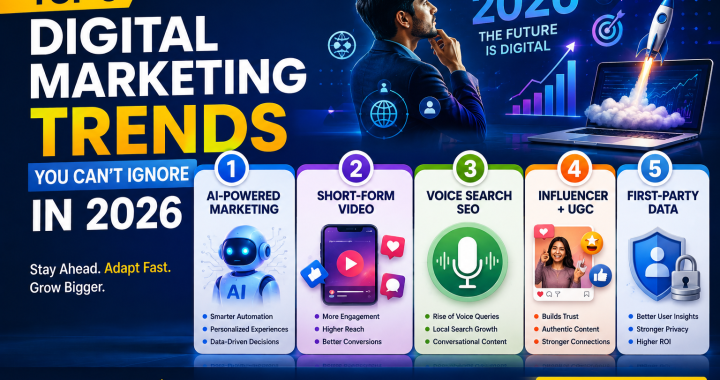
From AI-powered marketing to short-form video, voice search, influencer content, and first-party data, these marketing trends are shaping the next stage of online business growth.
Let’s explore the five trends businesses should not ignore.
1. AI-Powered Marketing
What Is AI-Powered Marketing?
Artificial Intelligence (AI) is becoming a major part of digital marketing. Businesses can use AI tools to analyze data, understand customers, create content ideas, automate tasks, and improve campaigns.
AI does not mean replacing marketers. Instead, it can help marketers work faster and make better decisions.
For example, an AI tool can help a marketer brainstorm blog topics, summarize customer feedback, organize campaign data, or create a first draft of an email.
Why Does It Matter?
AI can save time and help businesses handle large amounts of information.
It can help with:
- Faster content planning
- Customer segmentation
- Campaign analysis
- Personalized marketing
- Automated workflows
One of the most important digital marketing trends 2026 is the move from simply using AI for content creation to using AI throughout the marketing process.
How to Use It
Businesses should use AI as an assistant rather than blindly depending on it.
You can use AI to:
- Generate content ideas and outlines
- Analyze customer questions
- Personalize email campaigns
- Find patterns in marketing data
- Automate repetitive tasks
Always review AI-generated content before publishing it. Human creativity, experience, fact-checking, and brand understanding still matter.
2. Short-Form Video
What Is Short-Form Video Marketing?
Short-form video includes quick videos designed to communicate an idea in a short amount of time.
Platforms such as Instagram Reels, YouTube Shorts, and similar video formats have made short videos an important part of online content.
A business can use a 30-second video to show a product, answer a question, demonstrate a service, or share a customer experience.
Why Does It Matter?
People have limited attention, and short videos can communicate information quickly.
Short-form videos can help businesses:
- Increase brand awareness
- Show products in action
- Explain complicated topics simply
- Build a stronger connection with audiences
- Encourage social engagement
Video is also useful because it gives businesses a chance to show their personality instead of relying only on written advertisements.
How to Use It
You don’t need expensive equipment to start.
Try creating videos such as:
- “3 mistakes customers should avoid”
- “How our product works”
- “Before and after”
- “Frequently asked questions”
- “Behind the scenes”
Keep your videos useful, natural, and focused on one clear message.
Don’t make every video a sales pitch. Educational and entertaining content can help build trust.
3. Voice Search SEO
What Is Voice Search SEO?
Voice search allows people to search the internet by speaking into devices such as smartphones and smart speakers.
Instead of typing “best digital marketing agency Delhi,” someone might ask, “What is the best digital marketing agency near me?”
Voice searches are often more conversational than typed searches.
Why Does It Matter?
Search behavior is changing. People are using natural language when interacting with search engines and AI-powered assistants.
This means businesses should think beyond short keywords.
Voice-focused SEO can be especially useful for local businesses because people may search for nearby restaurants, stores, services, and businesses while using their phones.
How to Use It
To prepare your website for conversational searches:
- Answer common customer questions clearly.
- Use natural language in your content.
- Create FAQ sections.
- Optimize your Google Business Profile.
- Keep your business name, address, and phone details consistent.
Instead of writing content only around keywords, focus on answering the actual questions your customers ask.
4. Influencer + UGC
What Is Influencer and UGC Marketing?
Influencer marketing involves working with creators who have an audience that trusts their opinions.
UGC stands for User-Generated Content. This is content created by customers, such as product reviews, testimonials, photos, videos, and social media posts.
For example, a customer buying a skincare product may post a video showing their experience. With proper permission, the brand may be able to use that content in its marketing.
Why Does It Matter?
People often trust real experiences more than traditional advertisements.
Influencer and UGC marketing can help brands:
- Build social proof
- Increase trust
- Show products in real situations
- Reach niche audiences
- Create more authentic content
The key is authenticity. Working with a creator simply because they have a large follower count does not always guarantee good results.
How to Use It
Businesses can:
- Partner with relevant micro-influencers.
- Encourage customers to share their experiences.
- Ask for reviews and testimonials.
- Create campaigns around customer stories.
- Repurpose approved UGC across social media and websites.
Choose creators based on audience relevance, engagement, content quality, and trust—not just follower numbers.
5. First-Party Data
What Is First-Party Data?
First-party data is information a business collects directly from its customers or audience.
Examples include:
- Email subscribers
- Customer purchase history
- Website interactions
- Customer preferences
- Form submissions
- Loyalty program information
It is different from relying on data collected by outside companies.
Why Does It Matter?
Privacy expectations are increasing, and businesses need to build stronger direct relationships with their audiences.
First-party data can help companies understand their own customers and create more relevant experiences.
For example, an online store can use information customers voluntarily provide to send relevant product updates, recommendations, or offers.
This is an important part of the future of digital marketing because businesses need to build sustainable relationships rather than depend entirely on outside platforms.
How to Use It
Businesses can start collecting useful first-party data through:
- Email newsletters
- Customer accounts
- Website forms
- Loyalty programs
- Surveys
- Direct customer interactions
Always be transparent about what information you collect and how you use it. Give customers clear choices and follow applicable privacy laws.
How to Prepare for the Future
Knowing the marketing trends is useful, but simply knowing about them is not enough.
Businesses need to turn trends into practical actions.
1. Start Small
Don’t try to implement everything at once.
Choose one trend that matches your current business goal.
2. Understand Your Audience
Before investing in a new platform or technology, ask:
- Where does my audience spend time?
- What problems do they have?
- How do they search for information?
- What type of content do they trust?
3. Test and Measure
Don’t assume a trend will automatically work for your business.
Test different formats and track meaningful results such as:
- Leads
- Sales
- Engagement
- Website visits
- Customer retention
4. Combine Technology with Human Creativity
AI and automation can improve efficiency, but businesses still need people who understand customers, storytelling, creativity, and brand voice.
The strongest strategy is often a combination of technology and human thinking.
The Future of Digital Marketing
The future of digital marketing will be more personalized, conversational, data-driven, and AI-assisted.
Customers will continue to expect fast answers, useful content, authentic recommendations, and smooth online experiences.
At the same time, businesses will need to be more careful about privacy, transparency, and how they use customer information.
The brands that succeed will not necessarily be the ones using every new tool. They will be the ones that understand which technology actually helps their customers and business.
The most important digital marketing trends 2026 are therefore not just technology trends. They represent a change in how businesses communicate with people.
Conclusion
The online marketing landscape is changing quickly.
AI-powered marketing can improve productivity. Short-form video can capture attention. Voice search SEO can help businesses adapt to conversational searches. Influencer and UGC marketing can build trust, while first-party data can help companies develop stronger customer relationships.
These five trends are worth watching, but don’t follow trends simply because everyone else is doing it.
Choose strategies that match your audience, industry, goals, and resources. Start small, measure your results, and improve continuously.
As we move further into 2026, businesses that combine useful content, smart technology, authentic communication, and customer-focused marketing will be better prepared for the changing digital world.
Which trend will you try first? Comment below