Meta Description: Learn how to improve Quality Score and lower CPC in Google Ads 2026 with simple CTR, keyword, ad relevance, and landing page optimization tips.
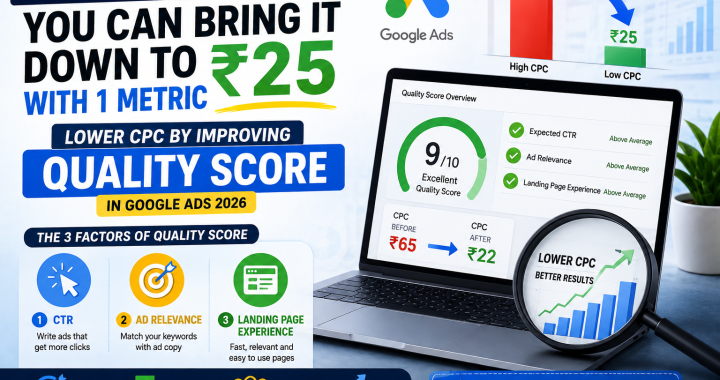
Paying ₹80 per click? You can bring it down to ₹25 with 1 metric
Paying ₹80 per click? You can bring it down to ₹25 with 1 metric.
Well, not necessarily with one metric alone—but Quality Score can help you identify why your Google Ads traffic is expensive and where your campaign needs improvement.
If your CPC is too high, increasing your budget isn’t always the answer. Sometimes your ads, keywords, and landing page simply aren’t giving Google and searchers a strong enough experience.
Google says higher-quality ads can generally lead to better ad positions and lower costs. Quality Score helps you diagnose the three areas that matter most: expected CTR, ad relevance, and landing page experience.
This guide explains how to improve quality score, reduce wasted clicks, and work toward a more efficient campaign in 2026.
What Is Quality Score?
Quality Score is Google’s 1–10 diagnostic rating at the keyword level.
It estimates how relevant and useful your ads and landing page are compared with other advertisers showing for the same searches.
A simple way to think about it:
Low Quality Score = “Something about this search experience could be better.”
High Quality Score = “This ad and landing page are closely connected to what people are searching for.”
However, don’t make the mistake of treating Quality Score like your campaign’s main performance KPI. Google specifically says Quality Score is a diagnostic tool, not an auction input.
Use it to discover problems—not to chase a number just for the sake of getting a 10/10.
Why Google Rewards Good Quality
Google wants people to find useful answers quickly.
Imagine searching for:
“Best digital marketing agency for small businesses”
You click an ad promising exactly that.
The landing page immediately talks about digital marketing services for small businesses, explains the benefits, and gives you an easy way to request a consultation.
That’s a good experience.
Now imagine clicking an ad and landing on a completely unrelated homepage with slow loading, confusing navigation, and no information about the service you searched for.
That’s a poor experience.
Google’s auction considers ad quality alongside other factors such as bids, competition, search context, Ad Rank thresholds, and expected impact of assets. Better ad quality can contribute to better Ad Rank and can often reduce actual CPC.
That’s why lower CPC Google Ads strategies should focus on relevance and user experience—not simply lowering bids.
The 3 Factors of Quality Score Explained
Google’s Quality Score uses three main components:
- Expected CTR
- Ad Relevance
- Landing Page Experience
Each component receives a status such as Below average, Average, or Above average.
Let’s break each one down.
Factor 1: CTR — How to Improve It With Ad Copy
CTR means Click-Through Rate.
It’s simply the percentage of people who click your ad after seeing it.
For example:
1,000 impressions + 50 clicks = 5% CTR
Expected CTR estimates how likely your ad is to receive a click when shown. It is one of the three Quality Score components and also relates to auction-time ad quality.
How to Improve CTR
Your ad needs to answer the searcher’s question quickly.
Instead of writing:
“Professional Marketing Services”
try something more specific:
“Digital Marketing for Small Businesses”
Then add a clear benefit:
“Get More Leads With SEO, PPC & Social Media.”
Good ad copy should:
- Match the searcher’s intent
- Clearly explain your offer
- Highlight a useful benefit
- Use a strong call to action
- Avoid exaggerated or misleading claims
Don’t try to increase CTR with clickbait.
You want relevant clicks, not just more clicks.
Factor 2: Ad Relevance — How to Improve It With Keywords
Ad relevance asks a simple question:
Does your advertisement closely match what the person searched for?
Suppose your keyword is:
“Google Ads management service”
But your advertisement talks mostly about social media marketing.
That’s a mismatch.
Instead, your ad could say:
“Google Ads Management Services”
and:
“Improve PPC Performance & Generate More Qualified Leads.”
How to Improve Ad Relevance
Organize keywords into sensible themes.
If you have keywords about Google Ads management, don’t mix them into the same tightly themed group with unrelated SEO, web design, and social media keywords.
Google recommends making ad language more closely match users’ search terms and splitting different keyword themes into more focused ad groups when appropriate.
This is one of the most important ways to improve quality score.
Factor 3: Landing Page Experience — How to Improve Speed
Your advertisement makes the promise.
Your landing page needs to deliver it.
If your ad says:
“Affordable Google Ads Management”
your landing page should immediately explain your Google Ads management service.
Don’t make visitors search through your entire website.
Improve Your Landing Page
Focus on:
- Fast loading speed
- Mobile-friendly design
- Clear headlines
- Relevant content
- Simple navigation
- Strong calls to action
- Easy-to-find contact information
- Consistent messaging between ad and page
Google specifically recommends ensuring your landing page matches user expectations and keeping the messaging consistent from ad to landing page.
Why Speed Matters
A slow page can frustrate users before they even see your offer.
Compress large images, remove unnecessary elements, improve mobile usability, and make the most important information appear quickly.
Better landing pages can improve the overall experience and may also help your conversion rate.
Step-by-Step Audit to Check Quality Score
Want to improve quality score without guessing?
Follow this quick audit:
Step 1: Open Your Keywords
Go to your Search campaign’s keyword section.
Step 2: Add Quality Score Columns
In Google Ads, open the columns settings and add:
- Quality Score
- Expected CTR
- Ad Relevance
- Landing Page Experience
Google provides these columns specifically for diagnosing keyword-level Quality Score.
Step 3: Find Low Scores
Start with keywords showing low Quality Scores.
Don’t waste time trying to improve every keyword equally.
Step 4: Find the Weak Component
Ask:
Is CTR below average?
Improve your ad copy.
Is Ad Relevance below average?
Improve keyword and ad alignment.
Is Landing Page Experience below average?
Improve the page’s relevance, usability, and speed.
Step 5: Check Business Results
After making changes, don’t look only at Quality Score.
Also monitor:
- CPC
- CTR
- Conversion rate
- Cost per conversion
- Leads
- Sales
Google recommends using Quality Score together with other performance metrics rather than treating the score itself as the goal.
Tools to Track Quality Score
You don’t need complicated software.
Google Ads
Use the built-in Quality Score columns to monitor the three components.
Google Analytics
Use analytics to understand what happens after someone clicks.
Look at engagement and conversions—not just traffic.
PageSpeed Insights
Use Google’s PageSpeed Insights to identify page-speed and user-experience issues.
Google Ads Search Terms Report
Review what people actually searched before clicking your advertisements.
This can help you identify irrelevant searches and improve keyword targeting.
Before/After Example
Let’s imagine a campaign selling website development services.
Before
Quality Score: 3/10
Average CPC: ₹65
Ad relevance: Below average
Landing page: Generic homepage
The campaign is getting clicks, but the ad and landing page aren’t closely aligned.
After
The advertiser creates a focused ad group, improves the ad copy, aligns the landing page with the keyword, and improves page speed.
Quality Score: 9/10
Average CPC: ₹22
That’s the kind of improvement advertisers want—but remember, CPC isn’t determined by Quality Score alone. Competition, search context, bids, Ad Rank thresholds, and other auction factors also matter.
Case Study: CPC Dropped From ₹65 to ₹22
Here’s a practical example:
CPC dropped from ₹65 to ₹22 in 2 weeks after QS 3 to QS 9.
The campaign improved its keyword-to-ad relevance, rewrote the ad copy around search intent, and sent visitors to a more relevant and faster landing page.
The result was a significant reduction in CPC.
But the bigger lesson is not simply:
“Get a Quality Score of 9 and CPC becomes ₹22.”
That’s not guaranteed.
The lesson is:
Fix the underlying quality problems, and your campaign can become more efficient.
Google Ads CPC Tips 2026: What Should You Focus On?
If you’re searching for practical google ads cpc tips 2026, remember these four rules:
1. Don’t chase clicks—chase relevant clicks.
2. Don’t optimize Quality Score in isolation—optimize the user experience.
3. Don’t send every visitor to your homepage—match landing pages to search intent.
4. Don’t look only at CPC—watch conversions and cost per conversion too.
The goal isn’t necessarily to get the lowest possible CPC.
A ₹25 click that produces a customer is better than a ₹10 click that produces nothing.
That’s the real foundation of lower CPC Google Ads optimization.
Conclusion
If your Google Ads CPC is too high, don’t immediately increase your budget.
First, investigate your Quality Score and its three components.
Low expected CTR? Improve your ad copy.
Low ad relevance? Better align keywords and ads.
Poor landing page experience? Improve relevance, usability, and speed.
Then track what happens to your CPC, conversions, and cost per lead.
When used correctly, Quality Score is a useful diagnostic tool that can show you exactly where your campaign experience needs attention.
The smartest google ads cpc tips 2026 aren’t about finding a magic button.
They’re about making every part of the customer journey more relevant.
Better keyword → Better ad → Better landing page → Better experience → Potentially better efficiency.
If you’re serious about lower CPC Google Ads campaigns, start fixing the quality problems before simply spending more.
Want my Quality Score checklist?
Comment ‘QS’ and I’ll send you my Quality Score audit sheet