Meta Description: Learn how to run Google Ads on a low budget in 2026. Discover five smart ways to reduce costs, attract quality leads, and grow your business.
Think you need ₹50,000 to run Google Ads? Wrong.
Think you need ₹50,000 to run Google Ads? Wrong.
If you’re a small business owner or startup, you may think Google Ads is only for companies with huge marketing budgets.
It isn’t.
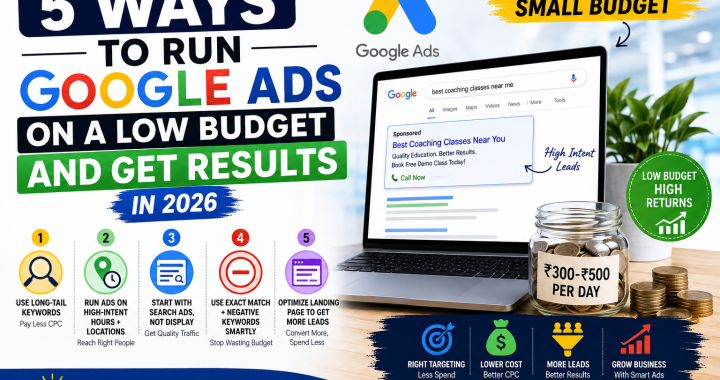
You can start with ₹300–₹500 per day, focus on the right audience, and build a campaign designed around quality rather than quantity.
The secret to google ads low budget campaigns isn’t spending more. It’s making sure every rupee has a purpose.
Instead of trying to show your ad to everyone, you want to reach people who are most likely to become customers.
In this guide, you’ll learn five practical ways to run google ads cheap while still giving your business a realistic chance to generate leads and sales in 2026.
How Much Budget Do You Really Need?
There is no universal minimum budget for Google Ads.
Your ideal budget depends on your industry, location, competition, average customer value, and the cost of relevant searches.
For a small local business, starting with ₹300–₹500/day can be a reasonable testing range.
For example:
₹500/day × 30 days = ₹15,000/month
That’s enough to collect useful information if you target your campaign carefully.
Don’t think of your first month as simply “spending money.”
Think of it as learning:
- Which searches bring customers?
- Which locations perform best?
- What time generates leads?
- Which ads get attention?
- Which landing page converts visitors?
- How much does a lead cost?
The goal of ppc on small budget 2026 campaigns is to find what works before increasing your spending.
5 Ways to Run Google Ads on a Low Budget
Way 1: Use Long-Tail Keywords to Pay Less CPC
Long-tail keywords are longer and more specific searches.
Instead of targeting:
“Digital marketing”
you could target:
“digital marketing agency for small business in Delhi”
The second search is more specific.
Someone typing a detailed search often has a clearer idea of what they want.
Long-tail keywords can also help you avoid competing for extremely broad searches.
Example
Suppose you’re a local home cleaning company.
Instead of targeting:
“cleaning”
you could focus on searches such as:
- “home deep cleaning service in [city]”
- “kitchen cleaning service near me”
- “professional house cleaning [city]”
These searches are more closely connected to your actual service.
Why It Helps
When you’re trying google ads low budget strategies, you don’t have enough money to waste on broad, low-intent traffic.
Specific keywords can help you focus your budget on people who are more likely to need your service.
Way 2: Run Ads Only During High-Intent Hours + Locations
Why show your ads 24 hours a day if your customers only contact you during certain hours?
If you’re running a small campaign, consider focusing your budget on the times when people are most likely to take action.
For example, a local service business might discover that most calls happen between:
9 AM–1 PM and 5 PM–9 PM.
Instead of spending equally throughout the entire day, you can analyze your results and prioritize stronger periods where appropriate.
Location targeting is equally important.
If you only serve customers in one city, don’t spend your limited budget targeting the entire country.
Example
A local dentist in Jaipur doesn’t need to pay for clicks from Mumbai if the business doesn’t serve Mumbai.
Focus your budget where your customers actually live.
This is one of the simplest ways to run google ads cheap without simply lowering your campaign quality.
Way 3: Start With Search Ads, Not Display
If your budget is only ₹300–₹500/day, you need to be careful about where your money goes.
Search Ads can be a strong starting point for businesses that want leads because they can reach people who are actively searching for a solution.
Imagine someone searches:
“best AC repair service near me”
That person already has a problem and may be ready to contact a service provider.
Compare that with someone casually browsing a website and seeing an advertisement for AC repair.
The first person may have stronger buying intent.
Why Search Can Be Better for Small Budgets
With limited money, you want your ads to appear when there is clear demand.
Once you understand which searches generate profitable results, you can explore additional campaign types as your budget grows.
For many small businesses, keeping the initial campaign focused makes ppc on small budget 2026 easier to manage.
Way 4: Use Exact Match + Negative Keywords Smartly
One of the biggest threats to a small Google Ads budget is irrelevant traffic.
Imagine you sell paid website development services.
You don’t necessarily want clicks from people searching for:
- Free website development
- Website development course
- Website developer jobs
- Website development tutorial
These people may not be potential customers.
Use More Focused Keywords
For your most important searches, tighter keyword targeting can help you control who sees your ads.
You can also use negative keywords to tell Google which searches you don’t want your advertisements to appear for.
For example, if you don’t offer free services, you may consider adding relevant searches involving “free” as negative keywords where appropriate.
Check Your Search Terms
Don’t set up the campaign and forget it.
Review the searches that triggered your advertisements.
If you find irrelevant searches, consider adding appropriate negative keywords.
This simple habit can make a major difference when you’re trying to run google ads cheap.
Way 5: Optimize Your Landing Page to Get More Leads From Less Clicks
Here’s something many advertisers forget:
Your ad isn’t the entire campaign.
You can have a great advertisement, but if your landing page is confusing, you can still lose potential customers.
Imagine you spend ₹500 and get 10 clicks.
If your landing page converts only one person, that’s one lead.
But if you improve the page and get two or three leads from the same 10 clicks, you’ve made your advertising much more efficient.
Your Landing Page Should Have
- A clear headline
- A simple explanation of your service
- Benefits for the customer
- Trust signals such as reviews or testimonials
- A strong call-to-action
- Easy contact options
- Fast loading speed
- Mobile-friendly design
Match the Ad to the Page
If your ad says:
“Affordable Home Tuition in Lucknow”
the landing page should immediately talk about home tuition in Lucknow.
Don’t send visitors to a generic homepage where they have to search for the service.
Better landing pages can help you generate more leads without simply buying more clicks.
Case Study: ₹500/Day Campaign
Let’s look at a simple example.
Suppose a local service business has a budget of:
₹500/day
Over 30 days:
₹500 × 30 = ₹15,000
Instead of targeting a huge area and hundreds of broad keywords, the business focuses on:
- High-intent local searches
- Specific long-tail keywords
- Relevant locations
- Strong business hours
- Negative keywords
- A dedicated landing page
The campaign generates 30 leads.
That means:
₹15,000 ÷ 30 = ₹500 per lead
If the business closes five customers and each customer is worth ₹5,000, the campaign produces:
₹25,000 in revenue from ₹15,000 ad spend.
This is only an illustration. Actual results vary significantly by industry, competition, offer, location, and conversion rate.
The point is that a smaller budget can still work when the campaign is focused.
Real Example: Local Tuition Got 15 Leads in 10 Days With ₹400/Day
Consider a local tuition provider running a focused search campaign.
The budget was:
₹400/day
For 10 days:
₹400 × 10 = ₹4,000
Instead of targeting broad education searches, the campaign focused on local, high-intent searches related to tuition services.
The business also used relevant negative keywords and sent visitors to a page specifically designed for tuition enquiries.
The result:
15 leads in 10 days.
That works out to approximately:
₹4,000 ÷ 15 = ₹267 per lead.
Again, this is an example rather than a guaranteed benchmark.
The important lesson is simple:
A small budget can work when you don’t waste it on people who aren’t your customers.
Tools to Monitor Your Spend
You don’t need expensive software to start managing a small Google Ads campaign.
Google Ads
Use your Google Ads account to monitor:
- Daily spending
- Clicks
- Search terms
- Keywords
- Ad performance
- Conversions
Google Analytics
Analytics can help you understand what visitors do after clicking your ads.
You can see whether people are engaging with your website and whether certain pages perform better.
Google Sheets
A simple spreadsheet can be extremely useful.
Track:
| Metric | What to Monitor |
|---|---|
| Ad Spend | How much you’re spending |
| Clicks | How much traffic you’re receiving |
| Leads | Number of enquiries |
| Cost Per Lead | Spend ÷ leads |
| Sales | Customers generated |
| Revenue | Money generated |
For a google ads low budget campaign, keeping track of these numbers helps you make decisions based on results rather than guesses.
What to Do When Your Budget Is Only ₹300–₹500/Day
If your budget is limited, don’t try to dominate every search.
Start narrow.
One location.
A small group of high-intent keywords.
A focused Search campaign.
A relevant landing page.
Strong negative keywords.
Then watch what happens.
When you find a campaign, keyword, location, or time period that consistently generates valuable leads, you can gradually increase spending.
That’s the smarter approach to ppc on small budget 2026.
Conclusion
You don’t need ₹50,000 to start advertising on Google.
You need a strategy.
With ₹300–₹500/day, your biggest advantage is focus.
Use long-tail keywords.
Target valuable locations and hours.
Start with Search Ads.
Control irrelevant searches with focused keywords and negative keywords.
And make sure your landing page turns clicks into enquiries.
Remember, the goal isn’t to get the most traffic.
It’s to get the right traffic.
If you’re willing to start small, track your results, and improve your campaign consistently, run google ads cheap doesn’t have to mean getting cheap results.
Start with what you can afford.
Learn.
Optimize.
Then scale what works.
Want my exact ₹500/day campaign structure?
Comment ‘BUDGET’ and I’ll send you my ₹500/day campaign template