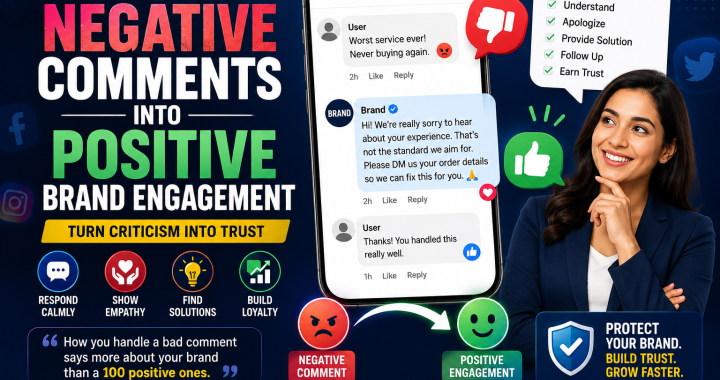
Meta Description: Learn how to handle negative comments professionally, protect your reputation, improve brand engagement, and turn criticism into customer trust.
1 bad comment can kill your brand… or make it 10x stronger
Every business eventually receives a negative comment.
Maybe a customer is unhappy with your product. Maybe someone complains about slow service. Maybe a follower simply wants to criticize your brand publicly.
Your first reaction might be to delete the comment, argue with the customer, or ignore it completely.
Don’t.
A negative comment isn’t always a threat. Handled correctly, it can become an opportunity to demonstrate professionalism, transparency, empathy, and excellent customer service.
In today’s digital environment, people don’t only judge brands by their products. They also watch how brands respond when something goes wrong.
That’s why learning to handle negative comments should be an essential part of every social media strategy.
Why Negative Comments Happen
Before responding, understand why people leave negative comments.
1. Genuine Customer Problems
A customer may have received a damaged product, experienced poor service, faced a delivery delay, or encountered a technical problem.
These complaints deserve serious attention.
2. Unmet Expectations
Sometimes your product isn’t necessarily bad—the customer simply expected something different.
Clear communication about pricing, delivery, features, quality, and results can reduce these situations.
3. Misunderstanding
A customer may misunderstand a promotion, policy, post, or product description.
A calm explanation can often solve the issue.
4. Emotional Reactions
Customers sometimes comment while frustrated. Responding emotionally can make the situation much worse.
5. Trolling
Not every negative comment deserves a lengthy response. Some people deliberately try to provoke businesses.
Knowing the difference between genuine criticism and trolling is an important part of social media crisis management.
The 5-Step Formula to Handle Negative Comments
When a negative comment appears, use this simple five-step process.
Step 1: Pause Before Responding
Don’t reply while you’re angry.
Take a moment to understand what happened. Check the customer’s order, conversation history, or relevant information before responding.
A rushed emotional response can turn a small complaint into a public crisis.
Step 2: Acknowledge the Concern
You don’t necessarily need to agree with everything the customer says.
But you should acknowledge their experience.
For example:
“We understand why this situation was frustrating, and we’re sorry you had this experience.”
This shows that you’re listening.
Step 3: Stay Professional
Avoid sarcasm, insults, defensiveness, or arguments.
Remember that you’re not only responding to one person. Your reply may be viewed by hundreds or thousands of potential customers.
A professional response communicates confidence.
Step 4: Offer a Solution
Whenever possible, move the conversation toward resolution.
You can ask the customer to send their order number, contact customer support, or message your official account.
The goal is to solve the problem—not simply win the argument.
Step 5: Follow Up
Don’t stop after sending the first reply.
If the problem is resolved, follow up with the customer where appropriate.
A complaint that ends with a successful resolution can sometimes create more trust than a customer who never experienced a problem.
This five-step process is one of the foundations of effective brand engagement 2026 strategies.
Two Reply Templates You Can Copy
Template 1: Genuine Complaint
Hi [Riyansh], we’re sorry to hear about your experience. We understand how frustrating this must have been. We’d like to look into this and make it right. Please send us your order/details via DM, and our team will assist you as quickly as possible.
Thanks for sharing your feedback, [Riyansh]. We’re sorry the experience didn’t meet your expectations. We genuinely appreciate you bringing this to our attention and will use your feedback to improve. Please DM us if you’d like our team to look into your specific experience.
Thanks for sharing your feedback, [Ayush]. We’re sorry the experience didn’t meet your expectations. We genuinely appreciate you bringing this to our attention and will use your feedback to improve. Please DM us if you’d like our team to look into your specific experience.
Template 2: Negative Feedback
Thanks for sharing your feedback, [Ayush]. We’re sorry the experience didn’t meet your expectations. We genuinely appreciate you bringing this to our attention and will use your feedback to improve. Please DM us if you’d like our team to look into your specific experience.