Meta Description: Compare WordPress vs custom website development in 2026 based on cost, speed, SEO, security, flexibility, maintenance, and business needs.
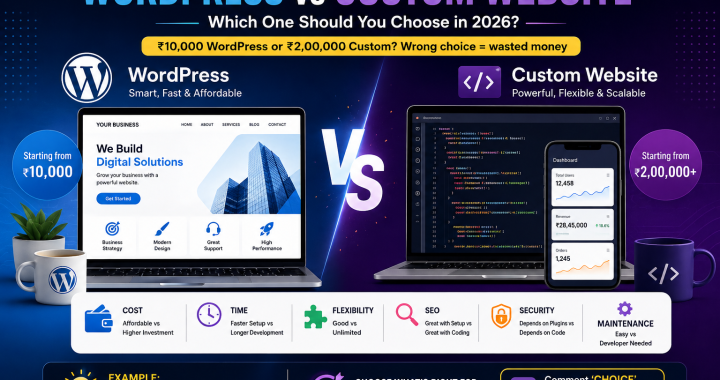
“₹10,000 WordPress or ₹2,00,000 Custom? Wrong choice = wasted money.”
Choosing a website platform can be confusing.
One developer says, “Go with WordPress. It is affordable and easy.”
Another says, “Custom coding is better. It gives you complete control.”
So, who is right?
The honest answer is: both can be right.
The best choice depends on your business model, budget, features, growth plans, and technical requirements.
In this guide, we’ll compare wordpress vs custom website development in simple terms so you can make a smarter decision in 2026.
What Is a WordPress Website?
WordPress is a popular content management system (CMS) that allows businesses to create and manage websites using themes, plugins, and customizable settings.
You don’t necessarily need to build every feature from scratch.
A WordPress website can be used for:
- Business websites
- Blogs
- Portfolio websites
- News websites
- Service websites
- E-commerce stores
- Landing pages
For example, a small digital marketing agency can use WordPress to create service pages, blogs, contact forms, testimonials, and landing pages without building everything from zero.
Pros of WordPress
- Lower initial development cost
- Faster to launch
- Huge selection of themes and plugins
- Easy content management
- Good for blogs and SEO
- Large developer community
- Easy to expand for many standard business needs
Cons of WordPress
- Plugins can create compatibility problems
- Poorly maintained plugins can create security risks
- Advanced customization may require coding
- Too many plugins can affect performance
- Ongoing updates are required
- Highly customized projects can become complicated
What Is a Custom Website?
A custom website is developed specifically for your business requirements.
Instead of relying mainly on ready-made themes and plugins, developers build the website’s functionality according to your specifications.
This approach can be useful when your business requires unique workflows, complex integrations, specialized dashboards, or functionality that standard WordPress solutions cannot handle efficiently.
Pros of Custom Websites
- Maximum flexibility
- Custom functionality
- Better control over architecture
- Can be designed around specific business processes
- Easier to create unique user experiences
- Suitable for complex integrations
Cons of Custom Websites
- Higher initial cost
- Longer development time
- Requires skilled developers
- Maintenance can be more technical
- Changes may cost more
- You may depend heavily on your development team
WordPress vs Custom: Comparison Table
| Factor | WordPress | Custom Website |
|---|---|---|
| Cost | Usually lower | Usually higher |
| Development Time | Faster | Longer |
| Flexibility | High for standard needs | Extremely high |
| SEO | Excellent with proper setup | Excellent with proper development |
| Security | Requires updates and careful plugin selection | Depends on coding quality and security practices |
| Maintenance | Themes/plugins need updates | Developer support may be required |
| Customization | High, but platform-dependent | Almost unlimited |
| Best For | Most standard business websites | Complex or highly specialized platforms |
So, which is better WordPress or custom?
There isn’t one universal answer.
A well-built WordPress website can outperform a badly developed custom website.
Likewise, a carefully developed custom platform can be far better than WordPress when the project requires complex functionality.
When to Choose WordPress – 4 Situations
1. You Have a Limited Budget
If you’re a startup, freelancer, local business, coach, or small business, WordPress can provide a professional website without requiring a huge initial investment.
You can start small and upgrade as your business grows.
2. You Need a Website Quickly
Need your website within days or a few weeks rather than months?
WordPress can significantly speed up development when your requirements are standard.
3. You Need a Blog or Content Website
WordPress is especially strong for content management.
If your strategy involves regularly publishing blogs, guides, case studies, or news, WordPress can be a practical choice.
Blog/Portfolio = WordPress. Banking App = Custom.
4. Your Requirements Are Standard
If you need:
- Home page
- About page
- Services
- Portfolio
- Blog
- Contact form
- Testimonials
- Basic lead generation
You probably don’t need an expensive custom system.
When to Choose Custom – 4 Situations
1. You Need Unique Functionality
Suppose you have a business process that doesn’t fit standard plugins.
A custom website may make more sense.
2. You’re Building a Complex Web Application
If your project involves dashboards, complex user accounts, real-time systems, advanced workflows, or specialized business logic, custom development may provide better control.
3. You Need Deep Integrations
If your platform needs to connect with multiple internal systems, APIs, databases, CRMs, payment systems, or specialized software, custom development can be a better fit.
4. Your Business Needs Maximum Scalability
Large platforms with unusual technical requirements may benefit from an architecture specifically designed around their expected scale and workload.
This doesn’t mean custom is automatically faster or more scalable.
It means the system can be engineered specifically for the requirements.
Hidden Costs of Both
The initial price isn’t the entire cost of a website.
Hidden WordPress Costs
A WordPress project may involve:
- Premium themes
- Paid plugins
- Hosting
- Security tools
- Backups
- Developer support
- Plugin updates
- Performance optimization
- Maintenance
A website advertised as ₹10,000 may cost more over time depending on what you add.
Hidden Custom Website Costs
Custom development can involve:
- Development hours
- UI/UX design
- Testing
- Hosting
- Security
- Bug fixing
- Developer maintenance
- New features
- Third-party integrations
If you need a new feature six months later, you may need a developer to build it.
That’s why you should consider total cost of ownership, not simply the initial development quote.
WordPress vs Custom Website for SEO
A common misconception is:
“Custom websites are automatically better for SEO.”
Not necessarily.
SEO depends on factors such as:
- Website speed
- Mobile usability
- Technical SEO
- Site structure
- Content quality
- Metadata
- Internal linking
- Search intent
- Crawlability
- Backlinks
- User experience
A properly optimized WordPress website can rank extremely well.
A custom website can also perform well when developers build it with SEO best practices from the beginning.
For most businesses, the platform is less important than how well the website is built and optimized.
Website Development 2026: What Matters Most?
The focus of website development 2026 shouldn’t simply be:
“Which technology is more advanced?”
Instead, ask:
“Which technology solves my business problem efficiently?”
A simple business doesn’t need unnecessary complexity.
Likewise, a complex technology business shouldn’t be forced into a platform that limits its core functionality.
Good website development 2026 is about choosing technology based on the actual business requirement.
My Recommendation
Here’s my honest recommendation.
Choose WordPress If:
You are a:
- Local business
- Freelancer
- Coach
- Consultant
- Blogger
- Small agency
- Portfolio owner
- Small-to-medium e-commerce business
And you need a professional website with standard features.
WordPress will probably give you a strong balance of cost, speed, flexibility, and manageability.
Choose Custom If:
You’re building:
- A complex SaaS platform
- A specialized marketplace
- A large web application
- A custom business management system
- A platform requiring unusual workflows
- A product with highly specialized functionality
Custom development may be worth the additional investment.
The important point is not to choose custom simply because it sounds more premium.
And don’t choose WordPress simply because it is cheaper.
Choose based on your actual requirements.
Which Is Better: WordPress or Custom?
The wordpress vs custom website debate doesn’t have a single winner.
Think about it like buying a vehicle.
If you need a reliable car for everyday travel, you don’t need to build one from scratch.
But if you’re creating a specialized racing machine, a standard vehicle may not meet your requirements.
The same principle applies to websites.
If your business needs a standard website, WordPress can be an excellent option.
If your business requires unique technology, custom development may be the better investment.
The right answer to which is better WordPress or custom depends on your goals, budget, timeline, and technical requirements.
Conclusion
Choosing between WordPress and custom development is one of the most important decisions you’ll make when building your online presence.
WordPress can offer affordability, speed, flexibility, easy content management, and a huge ecosystem.
Custom development can offer deeper control, specialized functionality, and solutions designed specifically around your business.
Before spending ₹10,000, ₹50,000, ₹2,00,000, or more, first understand what your business actually needs.
Don’t pay for complexity you don’t need.
But don’t choose a cheap solution that will become a limitation six months later.
The best website development 2026 strategy is simple:
Choose the technology that supports your business—not the technology that sounds impressive.
Comment ‘CHOICE’ and I’ll tell you which is best for your business in 2 mins.